
For years, Search Engine Optimization (SEO) has been the foundation of online visibility.
Businesses have invested heavily in content creation, technical optimization, backlink acquisition, site structure, and user experience improvements to improve search rankings and attract traffic.
Those principles remain valuable today.
However, something new is happening.
People are increasingly turning to AI-powered platforms such as ChatGPT, Google Gemini, Claude, and Perplexity to answer questions that were once handled almost exclusively through traditional search engines.
Instead of typing a query and reviewing multiple links, users are asking direct questions and receiving summarized answers.
This shift creates a new challenge.
How do AI systems determine which businesses, products, services, and resources to reference when generating answers?
This is where Answer Engine Optimization (AEO) enters the conversation.
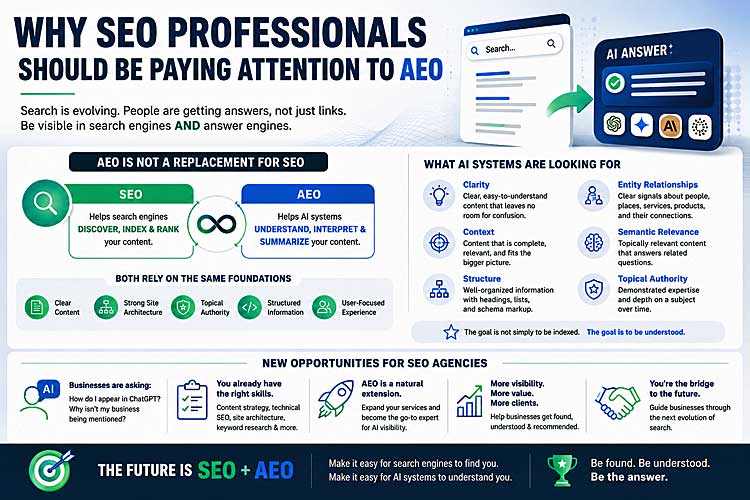
AEO Is Not A Replacement For SEO
One of the biggest misconceptions about AEO is that it somehow replaces SEO.
In reality, the two disciplines are highly complementary.
SEO focuses on helping search engines discover, index, and rank content.
AEO focuses on helping AI systems understand, interpret, summarize, and contextualize content.
Both rely on many of the same fundamentals:
- Clear content
- Strong site architecture
- Relevant topical authority
- Structured information
- User-focused experiences
AEO expands visibility considerations into AI-driven discovery environments.
Why User Behavior Matters
Technology changes when user behavior changes.
We saw it happen when mobile devices transformed web design.
We saw it happen when social media changed the way content is distributed.
And we’re seeing it happen again with AI-powered discovery.
Today, millions of people are asking questions such as:
- What is the best CRM for a small business?
- What is the best email marketing platform?
- Who provides the best local SEO services?
- What is the best project management software?
Instead of scrolling through ten blue links, many users now receive a direct answer, a shortlist, or a recommendation generated by AI.
This doesn’t eliminate traditional search.
But it does create an additional visibility channel that businesses can no longer afford to ignore.
What AI Systems Are Looking For
One reason AEO has gained attention is that AI systems consume and evaluate information differently than traditional search engines.
While rankings still matter, AI systems are also looking for signals related to:
- Clarity
- Context
- Structure
- Entity relationships
- Semantic relevance
- Topical authority
In many cases, the websites that perform well in AI-generated responses are not necessarily the sites with the strongest backlink profiles.
Instead, they are often the sites that communicate their purpose, expertise, products, and services in a way that is easy for AI systems to understand.
The goal is not simply to be indexed.
The goal is to be understood.
The Growing Importance of Structured Information
SEO professionals have long understood the value of schema markup and structured data.
AEO places even greater emphasis on these elements.
When AI systems evaluate content, structured information helps reduce ambiguity.
It provides context.
It helps answer questions such as:
- What is this business?
- What service does it provide?
- Who is it intended for?
- What problems does it solve?
- Why is it relevant?
As AI-driven discoveries grow, structured content may become increasingly important in helping systems interpret and reference websites accurately.
New Opportunities for SEO Agencies
Perhaps the most exciting aspect of AEO is not the technology itself.
It’s the opportunity.
Businesses are already asking:
- How do I appear in ChatGPT?
- Why isn’t my business being mentioned?
- How do answer engines evaluate websites?
- How can I improve AI visibility?
Many business owners don’t know where to start.
SEO professionals are uniquely positioned to help.
The skills required for successful AEO are closely related to skills that experienced SEO practitioners already possess:
- Content strategy
- Technical optimization
- Site architecture
- Keyword research
- Entity optimization
- Structured data implementation
Rather than replacing SEO, AEO may become a natural extension of the services many agencies already provide.
The Future Is Likely SEO Plus AEO
The discussion should not be framed as SEO versus AEO.
That creates unnecessary division between two disciplines that share many of the same goals.
The better question may be:
How can businesses improve visibility wherever people are searching for answers?
Today, that includes search engines.
Increasingly, it also includes answer engines.
The businesses that succeed will likely be those that focus on both discoverability and interpretability.
They will make it easy for search engines to find them.
And they will make it easy for AI systems to understand them.
Final Thoughts
SEO remains one of the most valuable digital marketing disciplines available.
That will not change anytime soon.
However, visibility itself is evolving.
As AI-powered discovery continues to grow, businesses, marketers, and agencies may benefit from expanding their optimization efforts beyond rankings alone.
The future may not belong to SEO.
The future may not belong to AEO.
The future may belong to those who understand how to combine both.
Businesses that can be found, understood, and recommended will likely have a significant advantage in the years ahead.
And for SEO professionals willing to adapt, it can create an exciting opportunity rather than a threat.
Click Here to learn about the AEO Visibility Suite.
